A custom CRM with AI agents inside
The CRM we use every day at FT Mercati: an assistant that carries out operations, plain-language filters, AI checks on quotes and contracts.
Case study
The CRM's Trade Fairs module: from any online exhibitor list to the visit, with an AI agent that collects, screens and matches against customer records.
In brief
The Trade Fairs module of FT Mercati's CRM starts from the exhibitor list any fair publishes online: an AI agent collects it, screens it for relevance to the company's services, checks websites and VAT numbers within a monthly cap and matches each exhibitor to the customer records. Then priorities, tablet visits with an offline queue, AI summaries of the matched customer's CRM notes. It is part of the CRM and also available as a standalone tool.
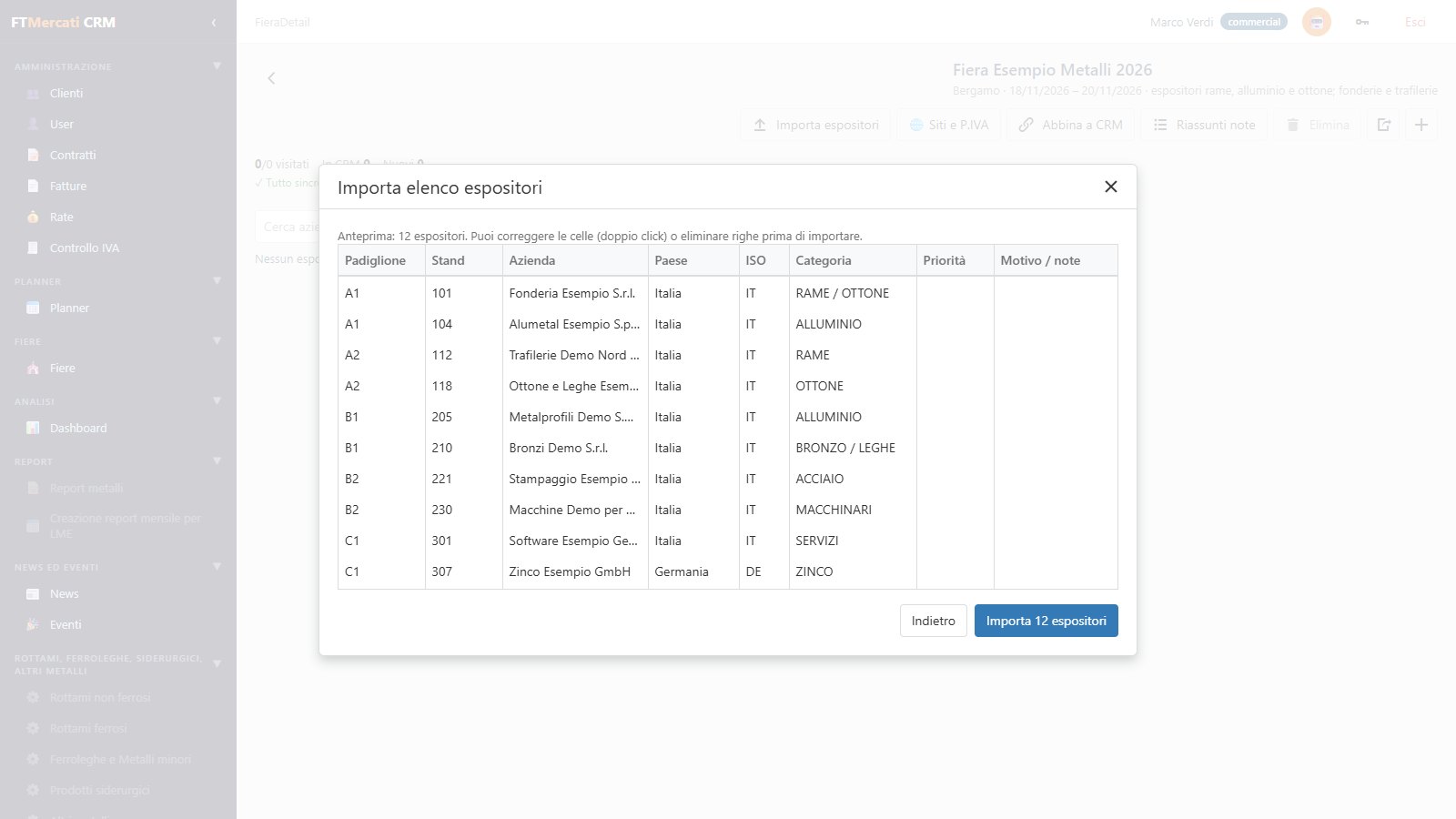
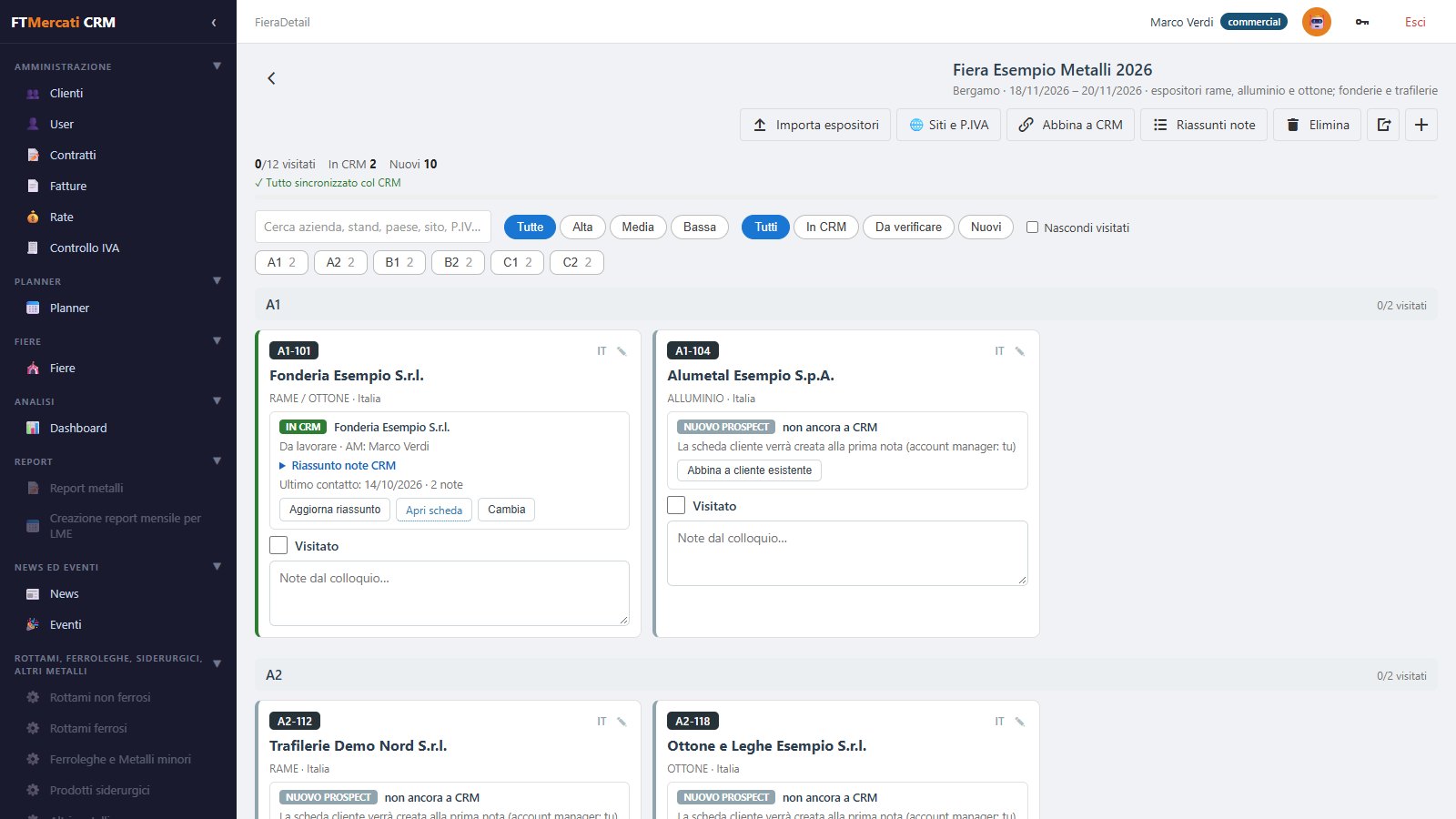
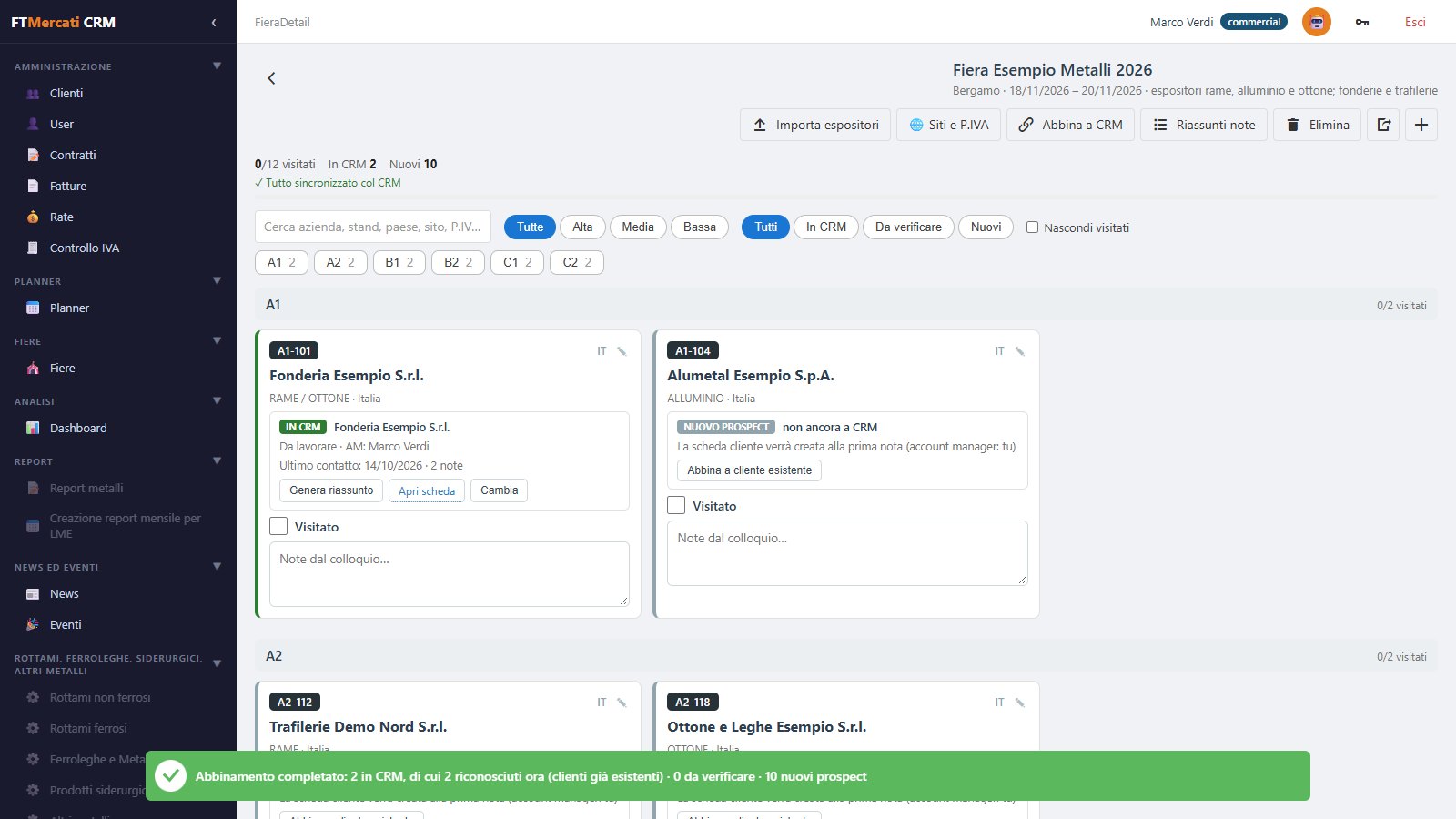
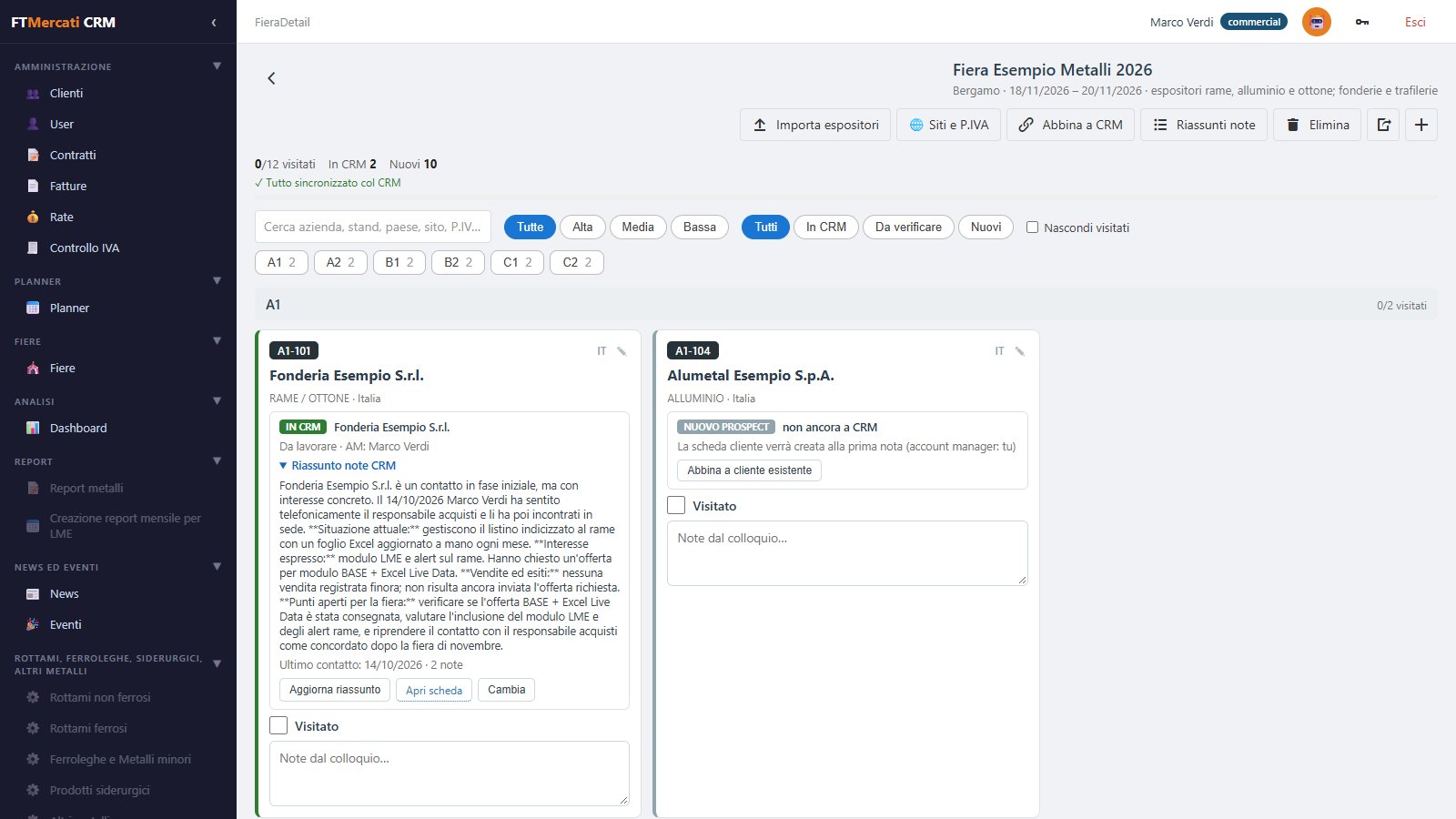
Screenshots from a demonstration environment with invented data: the companies, people and amounts are not real.
Anyone who sells services to an industry goes to that industry’s trade fairs. The work starts beforehand: downloading the exhibitor list, working out who the exhibitors are, checking whether they are already customers or have been in the past, deciding whom to visit and in which hall. Done by hand, on hundreds of names, it takes days and is done badly: incomplete names, unverified websites, duplicates in the customer records.
A complete “Trade Fairs” module inside the CRM with AI agents. It works with any fair that publishes its exhibitor list online, and has three ways to load the exhibitors: pasting the list, having artificial intelligence (AI) read it, or letting the scout agent extract it from the fair’s website.
The scout agent starts from the address of the website, browses pages, embedded frames and data endpoints, uses web search and, for sites built in JavaScript, a text extraction service. It collects the list of exhibitors, with the hall and stand of each one, and screens them for relevance to FT Mercati’s services: interest, sector, the company’s role in the metal supply chain (producer, user, trader or recycler, seller of machinery and services), talking point for the visit.
A second step, “Websites and VAT number”, checks the exhibitors’ websites, which is free, and searches the web for the VAT number and a description of the company, which costs money and therefore has a monthly cap on searches and a setting that switches them off. Then comes the matching to the CRM’s customer records: by VAT number, by website domain, by name, with a confidence level that depends on the source of the data.
At the fair the work is done on a tablet, with a queue that withstands the lack of network coverage in the halls; before the meeting, the AI sums up in a hundred words the history of the matched customer’s sales notes; the notes taken at the stand become CRM notes, without duplicates; new potential customers become customer records, and the VAT data of an EU company is completed on saving with the VIES check.
Inside the CRM the module shares everything: the customer records, the VAT rules and the VIES check, the salespeople and their roles, the assistant. A company that already has another ERP (the company’s management software) can have the module as a standalone tool: the same collection, the same screening and the same matching, connected to its own customer records. The module’s functions, in a list:
It is the first agent in our CRM that steps outside the management software and goes onto the web, and it serves as a model: a precise task, a set scope, spending caps, checks on the data found, a person who decides. The same pattern is useful for qualifying suppliers, for updating company records from websites, for preparing a round of visits; and the Trade Fairs module can also be had on its own, connected to the customer records the company already uses. We discuss it in the guide AI agents: what they are and what they can do and in the one on CRM with AI. If your sales team prepares for trade fairs with copy and paste, let’s talk.
Frequently asked questions
It is given the address of the fair's website and explores it as a patient person would: pages, embedded frames, hidden data endpoints, web search, text extraction from pages built in JavaScript. From this it derives the list of exhibitors, with the hall and stand of each one, and for each one it proposes a relevance rating.
It assesses them against FT Mercati's services with a criterion written into the prompt: interest, sector, the company's role in the metal supply chain (producer, user, trader or recycler, seller of machinery and services) and a talking point for the visit. It is a proposal: the salesperson can change priorities, delete in bulk the exhibitors that are not needed and keep only the ones to visit.
They are data about businesses, taken from public sources: the fair's website and the companies' websites. They stay in the CRM, matched to existing customer records or recorded as potential customers; paid searches have a monthly cap and a setting that switches them off, and every page is downloaded by a client that cannot reach internal addresses.
Yes. The relevance criteria and the ERP it matches against change; the method stays (collection, screening, matching with a confidence level, verification), and so do the limits: spending caps, a log, a person's confirmation on the uncertain cases.
The CRM we use every day at FT Mercati: an assistant that carries out operations, plain-language filters, AI checks on quotes and contracts.
The program we issue our e-invoices with: AI reads orders, CIG codes and declarations of intent from the notes, and a person confirms every invoice.
FT News: five AI agents find, write, review, approve and translate news on metals and commodities for FT Mercati's archive.
The engine that makes FT Mercati's PDF reports: charts and tables from the databases, the model's text on the data, a guardrail that stops what is wrong.
FT Rottami: seven ML.NET algorithms read the merchants' contributions and determine each week the changes in the prices recorded at the scrap yards.
An AI assistant that knows the whole project interviews the customer: it gathers requirements, explains the version under test, records the observations.
An AI adviser for senior management: it reasons on the organisation chart, strategic plan and company know-how, alongside FT Mercati market data.
The FT Mercati platform that changes the way commodity data is used: questions in plain language, answers with numbers, comparisons and charts.
Tell us about it in a first conversation, with no obligation: together we work out whether and where AI brings a measurable benefit, and which step to start with.