Case studies
Case studies: the AI we have already put into production
No imaginary customers and no inflated numbers: nine solutions built in-house, each with its declared status.
- 7 in production
- 1 working prototype
- 1 coming soon
In production · 7
In production
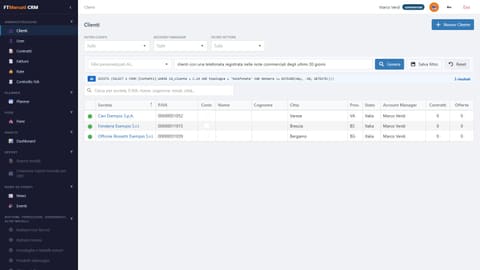
A custom CRM with AI agents inside
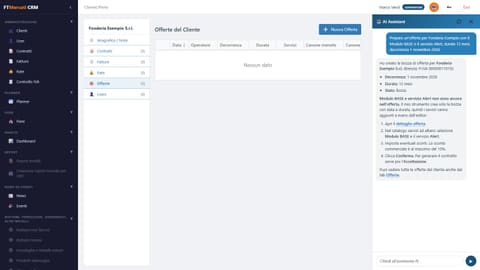
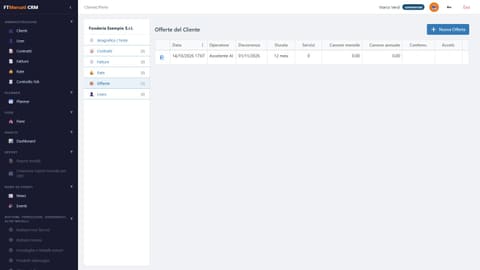
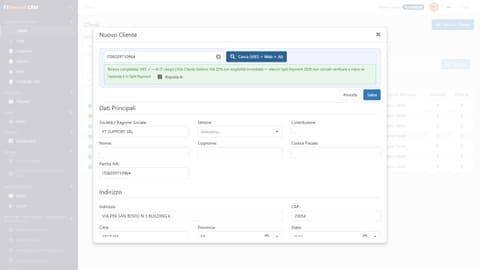
This is the CRM FT Mercati uses every day to manage customers, quotes, contracts and invoicing. We custom-built it and put AI where it saves time: an assistant that knows the CRM and can carry out operations, filters written in plain language, intelligent checks on the data, automatic reading of orders in PDF. Every action the AI takes goes through rules, roles and confirmations.
- 9 tools available to the agent, 5 of them read-only
- 59 screens, from customer records to management dashboards and trade fairs
- 5 languages covered by the AI translation of news, events and the service catalogue
- 2 roles with different permissions, which apply to the AI as well
- .NET 10
- Vue 3
- SQL Server
- Claude (Anthropic)
- VIES service
In production
E-invoicing with AI reading of customer notes
This is the program the accounts department of FT Mercati and FT Support uses every month to issue e-invoices for the contracts recorded in the CRM. Artificial intelligence (AI) does just one thing, tedious and delicate: it reads the administrative notes written by people and extracts the purchase order, the CIG code and the declaration of intent. Every failed reading is counted and flagged; every invoice is ticked and confirmed by a person.
- 3 AI readings from each customer's notes: purchase order, CIG, declaration of intent
- 3 invoicing modules, all on the same validated XML generator
- 1 human confirmation for every invoice: issuing is a single operation, all or nothing
- 2 programs that talk to each other: the CRM writes the notes in a canonical form, this one reads them back
- .NET 9 (WPF)
- SQL Server
- Claude (Anthropic)
- Italian e-invoice format FPR12
In production
A newsroom of AI agents for market news
FT News is FT Mercati's automatic newsroom for market news: five AI agents with distinct roles. The scout searches the web for sources across thirteen categories, the editor writes the draft in the language of the source, the reviewer scores it and can send it back, the chief editor approves, the translator produces the five languages. Written thresholds, a limit on revisions, a possible fallback to a second provider, a cost log.
- 5 agents with distinct roles: scout, editor, reviewer, chief editor, translator
- 13 categories covered, from LME metals to energy and the economy
- 5 languages for every news item: the original and four translations, with no duplicates
- 2 revisions at most before a draft is discarded
- 7 days of delay, at least, before a news item appears on the public website
- .NET 9 (WPF)
- SQL Server
- Claude (Anthropic)
- OpenAI (backup, if enabled)
- Web search (Tavily)
In production
Market reports in five languages, written with AI
FT Mercati's weekly and monthly reports, in PDF and in five languages, are made by an engine built by FT Support: charts, tables and numbers come from the databases; the model writes the commentary on the data it receives, in Italian, and translates it. Two model providers with automatic switchover on failure, and a guardrail that, if the text is missing, is a refusal or is in the wrong language, puts in a placeholder instead of sending it.
- 13 types of recurring report: eight weekly and five monthly, on metals, exchange rates, freight rates, plastics, oil and steel
- 5 languages for every report: written in Italian, translated into the other four
- 14 FT Mercati databases from which numbers, tables and charts are taken
- 2 model providers, with automatic switchover to the second on a technical error
- 7 steps in the news workflow, from preparing the query to the final check
- .NET 9
- SQL Server
- Claude (Anthropic)
- OpenAI (backup)
- QuestPDF
- AG Charts
- Quartz.NET
In production
An AI agent that prepares trade fair visits
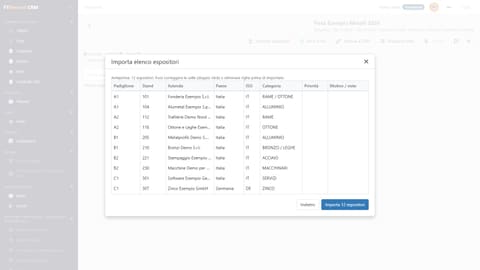
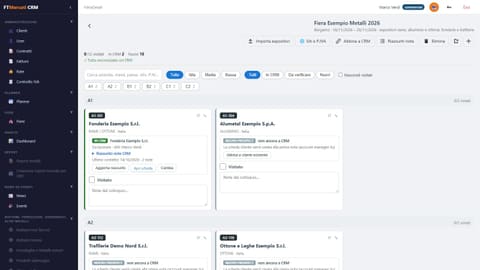
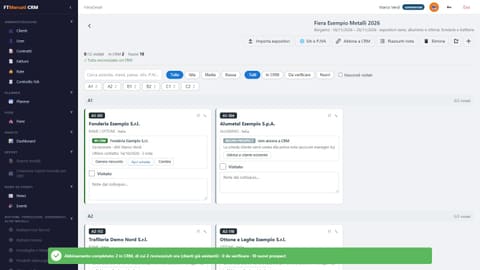
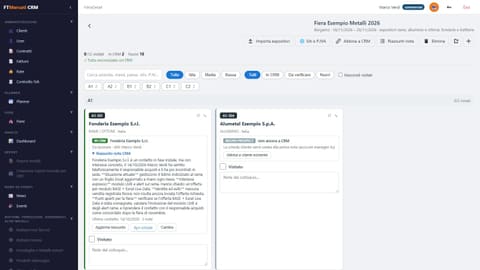
The Trade Fairs module of FT Mercati's CRM starts from the exhibitor list any fair publishes online: an AI agent collects it, screens it for relevance to the company's services, checks websites and VAT numbers within a monthly cap and matches each exhibitor to the customer records. Then priorities, tablet visits with an offline queue, AI summaries of the matched customer's CRM notes. It is part of the CRM and also available as a standalone tool.
- 3 ways to load the exhibitors: paste, AI reading, scout agent from the fair's website
- 3 keys for matching to the customer records: VAT number, domain, name, with a confidence level by source
- 1 monthly cap on paid web searches, with a setting that switches them off
- 8 seconds at most for the VIES check of a VAT number on saving
- 0 internal addresses reachable: every page is downloaded by a client that blocks them
- .NET 10
- Vue 3
- SQL Server
- Claude (Anthropic)
- Web search (Tavily)
- VIES service
In production
Machine learning in support of scrap quotations
FT Rottami is FT Mercati's machine learning system that reads all the contributions received from the merchants and determines the price changes for each category, as recorded at the yards: seven algorithms trained on five years of history, tested on sixteen months never seen before, with the group constraints enforced by rule. The weekly entry is automatic; the pricing team can review and correct. It is not a market forecast.
- 7 regression algorithms compared on the same data, tested in batches with different configurations and cross-validation
- 5 years of history for training, and sixteen months out of sample for testing
- 3 ways of combining the models: average, error-weighted average, median
- 3 blocks of categories that by rule move together, whatever the model says
- 1 scheduled entry per week, which writes only where a value is missing; the pricing team can always overwrite
- .NET 10
- ML.NET
- SQL Server
- Claude (Anthropic)
In production
Requirements and acceptance testing with AI
For a custom application, created to replace a spreadsheet the customer had used for over ten years, we built an AI assistant that has read the whole project, from the initial letter to the open questions. Through a personal link the customer talks to it whenever they like: it gathers requirements, explains the version under test, records and classifies observations, asks targeted questions. Everything is saved and read by the developers.
- 16 knowledge files in the project, in addition to the system prompt, archived as they are closed
- 180 questions in sixteen blocks in the longest interview, on the most complex topic of the project
- 5 categories for each observation: bug, unexpected behaviour, change request, question, positive feedback
- 1 main question per message, with the answers rephrased and confirmed in the customer's own words
- 0 promises: fixes, timescales, costs and decisions stay with people
- .NET 10 (Blazor Server)
- SQLite
- Claude (Anthropic)
Working prototype · 1
Working prototype
FT CEO: the AI assistant for decision makers
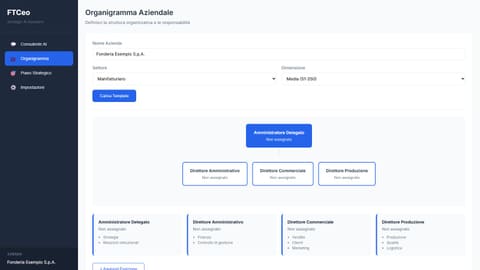
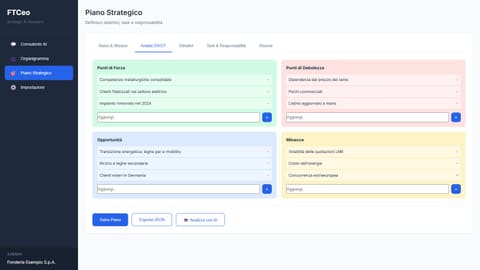
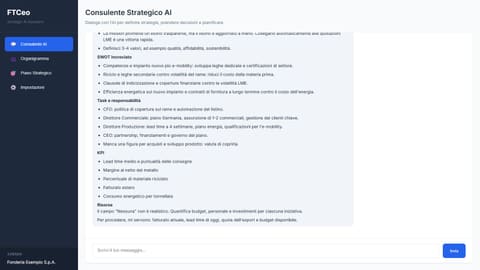
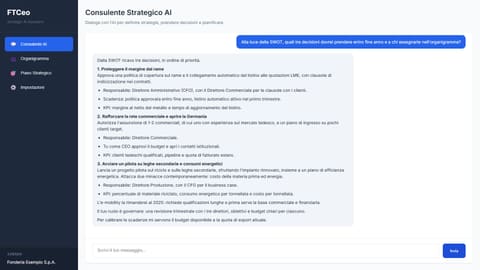
FT CEO is our assistant for the people who run a company: an AI adviser that reasons on the real context of the business (organisation chart, vision, SWOT analysis, objectives, responsibilities) rather than on generic advice. Today it is a working prototype. The direction of development is to combine company know-how with FT Mercati's market data and fundamental data, to support decisions on purchasing, prices and strategy.
- 3 work areas: AI adviser, organisation chart, strategic plan
- 4 ready-made organisation chart templates, from the start-up to the manufacturing company
- 2 interchangeable AI model providers, with no dependence on a single one
- Node.js
- Claude (Anthropic)
- OpenAI
Coming soon · 1
Coming soon
FT AI: ask your questions to commodity data
FT AI is the platform with which FT Mercati is changing the way commodity data is used: instead of searching through tables and charts, you ask a question in plain language, and the answer comes with numbers, a comparison and a chart. We are developing it on the data FT Mercati distributes every day: LME prices, Milan Indexes, scrap, exchange rates, fundamental data.
- 4 million time series of fundamental data, from 11 official sources
- 13 Milan Indexes calculated every day
- 5 languages served by the FT Mercati platform
- FT Mercati data
- Language models
- Charts generated from real data
In brief
FT Support has nine case studies. Seven are in production: the CRM with AI agents, e-invoicing with AI reading of customer notes, the newsroom of AI agents that writes market news, the engine that produces market reports in five languages, the Trade Fairs module with its agent, machine learning in support of scrap quotations and the assistant that gathers requirements and carries out acceptance testing on custom software. Then there are FT CEO, the AI assistant for decision makers, currently a working prototype, and FT AI, the platform coming soon for querying commodity data in natural language.
- 7 in production CRM with AI agents · Invoicing with AI reading · FT News: a newsroom of AI agents · FT Report: reports with AI · Trade Fairs module with AI agent · ML for scrap quotations · Requirements and testing assistant
- 1 working prototype FT CEO
- 1 coming soon FT AI
And more
Other things we keep running every day
Experience is not only in the projects with the AI label. It is in the systems that have to run, every day.
-
The FT Mercati platform
Web, iOS and Android apps, Excel components and APIs: commodity prices and data for over a thousand companies, in five languages, since 2010.
-
Fundamental data
A system that collects data from 11 official sources in the European Union, the United States and China: over 4 million time series, checked, labelled and updated automatically.
-
Translations in the CRM
Editorial news, events and the service catalogue go from Italian into English, French, Spanish and German with the language model, inside the CRM.
-
Milan Indexes
Thirteen price indexes calculated every day by formula from prices, premiums and exchange rates, published with their full history.
-
Custom management software
Desktop and web software delivered in versions, with installers, licences, release notes and ongoing maintenance.
Would you like to see one of these systems live?
We can show them to you in a short video call, and think through together what this could become in your company.